

What Does It Mean to “Set a Goal”?
The definition of goal setting
To set as a goal means to take an ambition, idea, or desired outcome and turn it into a defined, intentional target. Goal setting is the process of clarifying what you want and outlining the steps required to achieve it.
In simple terms:
A goal is a destination. Goal setting is the roadmap.
The science and psychology behind goals
Research in psychology consistently shows that humans perform better when they have clear, written goals. Goals activate both the conscious mind (planning) and the subconscious mind (focus and filtering opportunities).
Goal setting works because it:
- Creates direction
- Improves attention
- Boosts motivation
- Shapes decision-making
- Reinforces identity
The Definition of Goal Setting
Goal setting is the process of identifying what you want, clarifying why it matters, and outlining the steps required to achieve it. It helps turn vague ideas into clear outcomes and gives structure to your growth.
Whether you want to build a healthier lifestyle, grow in your career, learn a new skill, or improve your confidence, goal setting is the foundation that makes your progress intentional instead of accidental.
The Psychology Behind Setting Goals
Goal setting isn’t just motivational — it’s backed by decades of psychology research. Studies show that when you write down your goals:
- Your brain sharpens its focus
- Your motivation increases
- You spot opportunities more easily
- You make decisions with more clarity
- You build stronger self-belief
When you define what you want, your brain begins filtering out distractions and guiding your attention toward anything that helps you get closer to your goals.
That’s why goal setting works — it aligns your energy, your focus, and your identity.
Why people fail at setting goals
Most people don’t fail because they’re unmotivated—they fail because their goals are:
- Too vague
- Too big without steps
- Not measurable
- Not aligned with identity
- Not tracked consistently
This guide fixes that by giving you everything you need to set, track, and achieve goals effectively.
Looking for real-life examples to inspire your own goals? Check out these goal-setting examples.
Why Goal Setting Is Important
Goal setting is more than writing down what you want. It’s a way of giving your life direction, clarity, and purpose. When you choose a goal intentionally, you turn your energy toward the future you want — instead of drifting through the one you have.
Here’s why setting goals matters so much:
Goals Give You Motivation and Clarity
When you decide what you want, everything becomes easier.
You wake up with direction.
Your effort has meaning.
You stop wasting energy on things that don’t matter.
A written goal acts like a daily reminder:
“This is important to me.”
That sense of purpose naturally boosts your motivation.
Goals Create Focus and Reduce Distractions
Without clear goals, it’s easy to become overwhelmed or pulled in different directions. With goals, you suddenly know:
- what to say yes to
- what to say no to
- where to invest your time and energy
Focus becomes easier because you’re no longer trying to do everything — you’re working toward something.
Goals Build Confidence and Momentum
Every small win you achieve builds confidence.
Confidence builds more action.
Action builds momentum.
This momentum is what carries you forward even when motivation fades.
When you see yourself achieving goals — even tiny ones — you begin to trust your ability to follow through and grow.
You start seeing yourself not just as someone who wants to change…
but someone who can change.
Goals Support Personal and Professional Growth
Whether you want to:
- improve your health
- build better habits
- earn more
- grow your career
- improve relationships
- learn a new skill
Goal setting gives you a structured way to grow without feeling lost.
It turns big dreams into manageable steps and helps you measure your progress along the way.
Goals Transform “I Wish” Into “I Will”
A dream becomes a plan the moment you give it structure.
Without goals, your desires stay vague:
“I want to get fit.”
“I want to start a new career.”
“I want to be more confident.”
With goals, they become specific and actionable:
“I will walk 30 minutes daily.”
“I will apply for 10 jobs this month.”
“I will practice confidence-building exercises every day.”
Goal setting turns hope into action — and action into results.
Types of Goals Everyone Should Know
There’s no “one right way” to set goals. Different goals serve different purposes, and understanding the types of goals you can set makes the process easier, clearer, and more meaningful.
Below, you’ll find the most powerful goal types — the ones people use to grow, improve, and transform their lives. Mix and match the types that resonate with you.
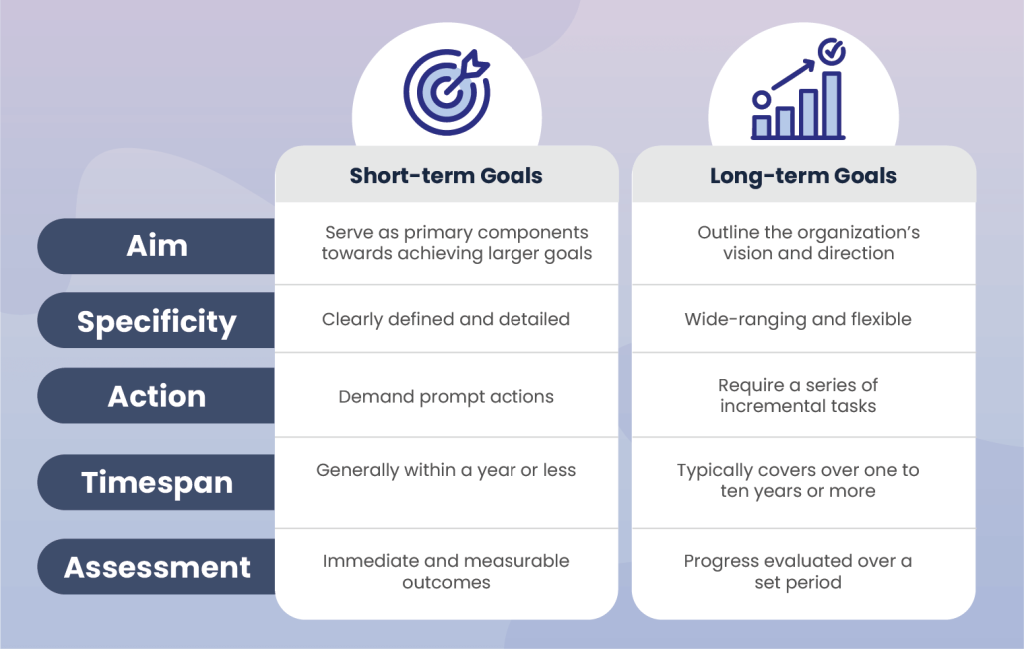
Short-term goals
Short-term goals are goals you can achieve in days, weeks, or a few months.
They give you quick wins, build momentum, and help you stay motivated.
Examples:
- Walk 10,000 steps daily this week
- Read 10 pages of a book every day
- Apply to three jobs this month
Short-term goals are the stepping stones to bigger changes.
Long-term goals
Long-term goals are your bigger visions — the goals that shape the direction of your life over months or years.
Examples:
Complete a degree or certification
Get a promotion
Improve long-term financial stability
Personal goals
These are goals that help you grow as a person — mentally, emotionally, or physically.
Examples:
Practice mindfulness regularly
Build confidence
Improve daily habits
Strengthen relationships
Professional goals
Career and work-related goals help you grow professionally, increase your skills, or improve your performance.
Examples:
Lead a project at work
Improve communication skills
Achieve a higher performance review
Learn a new professional skill
Academic or Student Goals
These goals support personal development for students at any level.
Examples:
- Improve study habits
- Complete assignments on time
- Raise GPA
- Participate in academic programs
Habit goals vs outcome goals
Outcome goals focus on the final result.
Example: “Lose 10 pounds.”
Habit goals focus on the daily actions that create the result.
Example: “Walk 30 minutes every day.”
Most successful people combine both.
SMART Goals (Specific, Measurable, Achievable, Relevant, Time-Bound)
SMART goals help you create goals that are clear and achievable.
This is one of the most popular goal-setting frameworks because it removes guesswork and increases accountability.
Financial Goals
These goals help you improve money habits and reduce financial stress.
Examples:
- Save a fixed amount each month
- Pay off debt
- Build an emergency fund
- Increase income streams
Fitness and Health Goals
These goals support your mental and physical well-being.
Examples:
- Exercise three times per week
- Improve sleep quality
- Build strength or endurance
- Reduce sugar or unhealthy habits
Lifestyle or Life Goals
These goals shape the kind of life you want to live.
Examples:
- Travel more
- Build meaningful friendships
- Spend more time with family
- Create work–life balance
How to Set a Goal (Step-by-Step Guide)
Step 1 — How to create goals
Start by writing down what matters most—your aspirations, needs, dreams, and challenges.
Step 2 — How to establish goals
Turn your ideas into clear statements. Example:
Instead of “lose weight,” write “lose 10 pounds by July.”
Step 3 — How to make goals specific
You must know exactly what success looks like. Define:
- What you want
- How you’ll measure it
- When it will happen
Step 4 — How to accomplish goals (execution planning)
Break the big goal into small milestones. Create a weekly schedule that supports those milestones.
Step 5 — Achieve these goals (progress management)
Tracking is everything. Review your goals weekly, adjust monthly, and celebrate progress.
The SMART Goal Framework
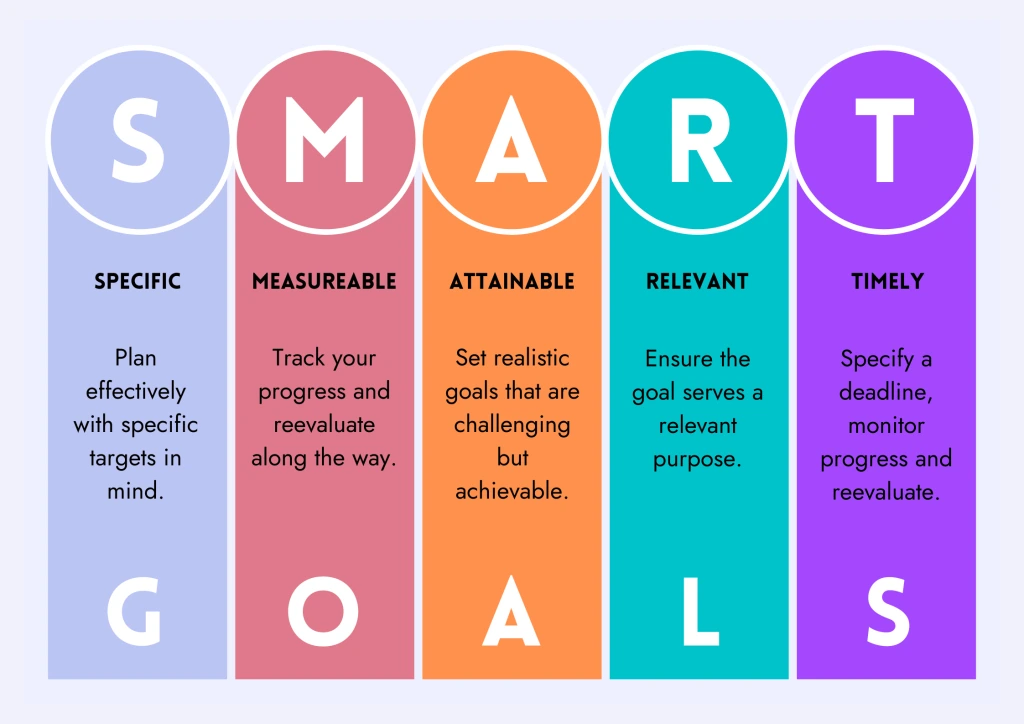
The SMART goal method is one of the most popular and reliable ways to set clear, achievable goals. It removes guesswork, increases motivation, and helps you stay committed long enough to see real results.
SMART stands for:
- Specific
- Measurable
- Achievable
- Relevant
- Time-bound
When you use this framework, you turn your goals into a step-by-step plan you can follow confidently.
Let’s break it down.
Specific
A specific goal clearly defines what you want to achieve.
Instead of:
❌ “Get in shape.”
Try:
✔ “Exercise for 30 minutes, 4 days a week.”
Instead of:
❌ “Improve my career.”
Try:
✔ “Complete an online certification by September.”
Being specific removes confusion and gives you clarity.
Measurable
A measurable goal includes a number, frequency, or milestone so you can track progress.
Examples:
- Save $200 a month
- Lose 5 pounds in four weeks
- Read one book every month
- Apply to 10 jobs this month
Measurable goals help you see progress — which boosts motivation
Achievable
Your goal should stretch you, but still be realistic.
Ask yourself:
- “Is this goal possible with my current time and resources?”
- “What is the next step I can absolutely accomplish?”
Achievable goals build confidence, and confidence builds momentum.
Relevant
Relevant goals align with your values, lifestyle, and long-term dreams.
If a goal doesn’t matter deeply, you won’t stay committed.
Examples:
- If your long-term dream is freedom → set financial goals
- If your dream is confidence → set habit-based goals
- If your dream is a strong career → set performance or skill goals
This is where you connect your goals to your purpose.
Time-bound
A goal without a deadline is just a wish.
Examples:
- “By June 1st…”
- “In the next 90 days…”
- “Every week for the next month…”
Deadlines create urgency and structure.
SMART Goals for Work
Examples:
- “Attend two professional workshops this quarter to improve leadership skills.”
- “Increase productivity by completing daily tasks by 4 PM for the next 30 days.”
- “Improve communication by giving weekly updates to the team for 6 weeks.”
SMART Goals for Students
Examples:
- “Study math for 30 minutes daily for the next 4 weeks.”
- “Finish all assignments at least 24 hours before the deadline for one semester.”
- “Improve GPA from 2.8 to 3.2 this academic year.”
SMART Goals for Fitness & Health
Examples:
- “Run 3 times a week for 20 minutes for the next 2 months.”
- “Reduce sugar intake by 50% in 30 days.”
- “Sleep 7 hours every night for the next 21 days.”
Advanced Goal-Setting Strategies
Once you understand the basics of setting goals, you can take things to the next level with advanced strategies. These aren’t just techniques — they are mindsets and systems that help you become the kind of person who naturally follows through.
These methods help your goals feel easier, more enjoyable, and more aligned with who you truly want to be.
Let’s explore the strategies that can transform not just your goals… but your entire life.
Identity-based goals
Instead of focusing on what you want to achieve, focus on who you want to become.
Most people set goals like:
“I want to lose weight.”
“I want to be more confident.”
“I want to wake up earlier.”
Identity-based goals shift the focus:
“I am becoming a healthy person.”
“I am becoming a confident communicator.”
“I am someone who wakes up early.”
When your identity changes, your behavior follows.
Reverse Engineering Your Goals (Start With the End in Mind)
This method helps you set realistic, structured goals by working backwards.
Ask yourself:
- What does my end result look like?
- What must happen right before that?
- And before that?
Example:
Goal: Run a 5K
Reverse engineer:
- Week 8: Run 5K
- Week 6: Run 3K
- Week 4: Run 2K
- Week 1: Run 500m
This makes even big goals feel achievable.
Goal stacking (Connect Small Goals to Build Momentum)
Goal stacking means linking smaller goals together so they support one bigger transformation.
Example:
Big goal → Improve your health
Stack:
- Drink more water
- Walk daily
- Sleep 7 hours
- Reduce sugar
Small wins compound into big change.
Habit loops
Cue → Routine → Reward
Every habit is built on a loop:
- Cue — the trigger
- Routine — the action
- Reward — the benefit
Example:
Cue: Morning alarm
Routine: Drink a glass of water
Reward: Feel refreshed and awake
Understanding habit loops makes it easier to build habits that support your goals.
Habit Stacking (Attach a New Habit to an Existing One)
This technique comes from the work of habit experts and is incredibly simple:
“When I [existing habit], I will [new habit].”
Examples:
- After brushing my teeth → I meditate for 2 minutes
- After lunch → I take a 10-minute walk
- After opening my laptop → I review my top 3 tasks
This method removes friction and makes new habits effortless.
Keystone Habits (The Habits That Transform Everything)
Keystone habits are small habits that start a chain reaction of positive change.
Examples:
- Daily exercise
- Planning your day
- Journaling
- Eating healthy
- Waking up early
When you install one keystone habit, many other habits become easier.
Systems vs goals (James Clear Method)
Goals give you direction.
Systems create results.
If your goal is to write a book, your system is:
- Writing daily
- Setting writing blocks
- Reducing distractions
Systems ensure progress even when motivation fades.
This method is powerful for anyone who struggles with consistency.
The OKR Method (Objectives and Key Results)
OKRs are used by top companies, but they work beautifully for personal goals too.
- Objective: What you want to achieve
- Key Results: How you will measure success
Example:
Objective: Improve fitness
Key Results:
- Run 3 times a week
- Reduce body fat by 3%
- Reach 10,000 daily steps
OKRs help you stay focused and accountable.
Common Mistakes in Goal Setting (and How to Avoid Them)
Most people don’t fail because they’re unmotivated.
They fail because they make simple mistakes that quietly pull them off track.
The good news?
Once you understand these mistakes, they become incredibly easy to fix.
Here are the most common goal-setting mistakes — and how you can avoid them.
Setting Goals That Are Too Vague
When your goal is unclear, your brain doesn’t know where to start.
Vague:
❌ “Get healthier.”
Clear:
✔ “Walk 30 minutes every morning.”
Clarity removes confusion and replaces it with direction.
Setting unrealistic or Overwhelming Goals
People often set goals that require enormous change overnight.
But big change comes from small, steady steps.
Unrealistic goals create pressure → pressure becomes avoidance.
Instead, break goals into realistic milestones that match your time, energy, and lifestyle.
Setting Too Many Goals at Once
Having too many goals splits your focus.
Most people can only maintain momentum on 1–3 major goals at a time.
Your energy is limited — invest it wisely.
Not Breaking Big Goals Into Smaller Steps
This is one of the biggest reasons goals fail.
A large goal without steps feels overwhelming.
But small, manageable steps make progress feel natural and achievable.
Example:
Instead of “Write a book,” break it down into small milestones like writing 500 words per day.
Not tracking progress
If you don’t track your progress, your motivation slowly fades.
Tracking creates awareness.
Awareness builds momentum.
Try reviewing your goals weekly or using a goal sheet or goal management app
Lacking clarity
Vague goals create vague results.
Relying only on motivation
Motivation is temporary; systems and habits are permanent.
Motivation comes and goes — that’s normal.
But systems, habits, and routines are reliable.
If you rely solely on motivation, your progress will always feel inconsistent.
Examples of Well-Defined Goals
Sometimes all you need is a few clear examples to spark your own ideas.
Great goals share one thing in common: they’re specific, realistic, and deeply connected to what you truly want.
Below are practical, well-defined examples across different areas of life.
Use these as inspiration to create your own powerful goals.
Personal life examples
These goals help you grow emotionally, mentally, or in your daily routines.
Examples:
- “Read one personal development book each month.”
- “Wake up 30 minutes earlier for the next 60 days to build a morning routine.”
- “Declutter one room every weekend for a month.”
- “Write in a journal three times a week to improve self-awareness.”
Career & Professional Goals
Career goals help you grow your skills, confidence, and workplace performance.
Examples:
- “Complete a professional certification within the next 90 days.”
- “Lead one team project this quarter to build leadership experience.”
- “Improve communication by delivering weekly team updates for the next 6 weeks.”
- “Increase productivity by finishing daily tasks by 4 PM for one month.”
- Improve communication skills
- Grow professional network by attending 3 events
Academic or Student Goals
These goals help students build discipline, better habits, and academic confidence.
Examples:
- “Study math for 30 minutes every day for the next 4 weeks.”
- “Improve GPA from 2.8 to 3.2 by the end of the school year.”
- “Submit all assignments 24 hours early for one semester.”
- “Join one club or activity this term for personal growth.”
Fitness and health examples
Health goals increase energy, reduce stress, and strengthen your wellbeing.
Examples:
- “Run 3 times a week for 20 minutes for the next 8 weeks.”
- “Drink 8 glasses of water daily for 30 days.”
- “Exercise for at least 30 minutes, 4 days a week for two months.”
- “Reduce sugar intake by 50% over the next 30 days.”
Tools and Resources for Achieving Goals
You don’t have to rely on motivation alone. With the right tools, templates, and systems, achieving your goals becomes easier, faster, and more enjoyable.
Below are supportive resources you can begin using today to stay organized, stay focused, and stay consistent. These tools help you turn your goals into daily habits — and your daily habits into long-term success.
Goal-setting apps
If you love staying organized digitally, goal-setting apps are a great way to track habits, set reminders, and monitor your progress daily.
Printable worksheets
A worksheet makes your goals feel real. Writing things down creates clarity — and clarity creates action.
Printable worksheets help you:
- Break goals into steps
- Track habits
- Review your week
- Reflect on your progress
- Stay organized without overwhelm
These are perfect if you prefer a hands-on, visual approach.
SMART Goal Templates
If you want a quick, easy way to turn vague ideas into structured goals, a SMART template is your best friend.
SMART templates help you:
- Clarify your goals
- Make them measurable
- Stay aligned with your purpose
- Set realistic deadlines
- Build in accountability
Coaching, planners, and journals
Some goals are easier — and more enjoyable — when you don’t pursue them alone.
Accountability helps you:
- Stay consistent
- Stay motivated
- Stay honest with yourself
- Take action even on tough days
- Get advice, feedback, and support
This is especially powerful for people who struggle with consistency, clarity, or follow-through.
Want Personalized Support With Your Goals?
Tools are powerful — but sometimes the biggest breakthroughs happen when someone guides you step by step.
If you want:
- Clear direction
- A customized goal plan
- Weekly accountability
- Motivation that lasts
- Support through challenges
A coach can help you turn your goals into real, lasting success.
Explore Goal Setting Coaching Services to get personalized support on your journey.
How to Stay Motivated and Achieve That Goal
Setting a goal is the first step — staying motivated is where the real transformation happens.
No one feels motivated every day, and that’s okay. What matters is creating a system that helps you stay consistent even when your motivation dips.
Here are simple, powerful ways to stay committed to your goals and make steady progress.
Accountability frameworks
Share your goals with friends or mentors.
Reward systems
Celebrate small wins to increase dopamine and motivation.
Tracking tools
Use habit trackers, calendars, or apps.
How to get back on track when you slip
Mistakes are part of the journey—what matters is recommitment, not perfection.
Conclusion
Goal setting is all about clarity, direction, and small daily actions that lead to big change. You don’t need the perfect plan — you just need a clear goal and the courage to take the next step.
Start small. Stay consistent. Believe in your progress.
Your goals will grow as you grow.
If you want personalized support, explore Goal Setting Coaching Services to stay motivated and on track.
FAQ Section
1. What does it mean to set a goal?
It means defining a clear, specific outcome you want to achieve and creating a plan to reach it.
2. Why is goal setting important?
Goal setting gives clarity, direction, focus, and motivation for long-term success.
3. How do I create goals effectively?
Start by identifying what matters most, writing it down, and using frameworks like SMART.
4. What are examples of good goals?
Fitness goals, financial goals, career goals, and personal development goals.
5. Why do people fail to achieve goals?
Because their goals lack specificity, tracking, or realistic planning.